9 Smart Answers and 9 Smart Questions for Job Interviews

By salary.com and Rachel Weingarten on LADDERS

This article addresses how to respond to the following “gotcha” questions interviewers use to weed out the excellent candidates from the good ones:

  1. What is your biggest weakness?
  2. Why do you want to leave your current job?
  3. What are your salary requirements?
  4. Why should we hire you?
  5. Why do you want to work here?
  6. Can you explain this gap in your work history?
  7. Can you tell me a little bit about yourself?
  8. Can you tell me about a time something didn’t go to plan?
  9. Can you tell me about a time you’ve clashed with a supervisor?

This one, in contrast, details excellent questions you can ask your interviewer at the end, and what the interviewer’s answers can tell you. Remember, an interview is a two-way conversation…you don’t have to be left guessing! A few of the below questions might help you to figure out if the job is a good fit for you, and to look for red flags.

  1. Why did you join the company?
  2. How does this role further the company’s mission?
  3. Tell me about your most successful employees.  What do they do differently?
  4. What do you expect someone in this position to accomplish in the first 60-90 days?
  5. What, if anything, in my background gives you pause?
  6. What is the turnover in your company, in the executive suite and in the department, I am interviewing for?
  7. What are the opportunities for growth and advancement?
  8. What haven’t I asked that most candidates ask?
  9. What are the next steps in this process?

Many of us are facing employment insecurity right now, and the job market is tough. However, there are opportunities out there, and you can distinguish yourself from other candidates with smart questions and answers in an interview. You probably won’t use all of these every time…instead you can pick and choose depending on the job and how the interview has gone. Don’t be afraid to write some down in a notebook beforehand and take it in with you! Even if you are not currently job hunting, it may be worth your while to give the linked articles a read and keep what you learn in your back pocket. I believe in all of you.
Free Help with Federal Tax Filing

Hello everyone! This is a bit of an unconventional post to put here, but ’tis the season to do taxes, and I figured this resource could be of some use to those of you that, like me, have really busy schedules and can’t handle the headache that comes with figuring out tax forms alone.

I just found this out this year, but it turns out that if you make less than $69,000 per year, you can access software like TurboTax, H&R Block, etc, that guides you through filling out your taxes online, for free. This service is offered through the IRS Free File program…and tax companies like those mentioned above have tried really hard to keep people from finding out about it! Last year, TurboTax caused a bit of a scandal when it tried to hide its Free File page from search engines (in an attempt to mislead people eligible for free filing into paying money for the exact same service).

I’ve actually used Free File to file my own taxes this year, and it was really helpful. Just make sure if you use it you have digital copies of the needed forms; I know some workplaces send them out, some don’t. If you don’t have digital copies, some of the tax software Free File offers allows you to take a photograph of a paper copy and then fill in the information digitally. If it sounds like it’ll make filing into even more of a headache, don’t worry about it! For me, using technology makes taxes easier. For others, it may be the opposite.

Again, a bit of an unconventional post here, but part of the beauty of humanities is learning to snoop around in all areas of life and see what’s available to help us! Plus, the MISC category exists on this website for a reason. I hope this resource proves useful to those of you that didn’t know about it already, and next time we’ll be back to your regularly scheduled academic postings.

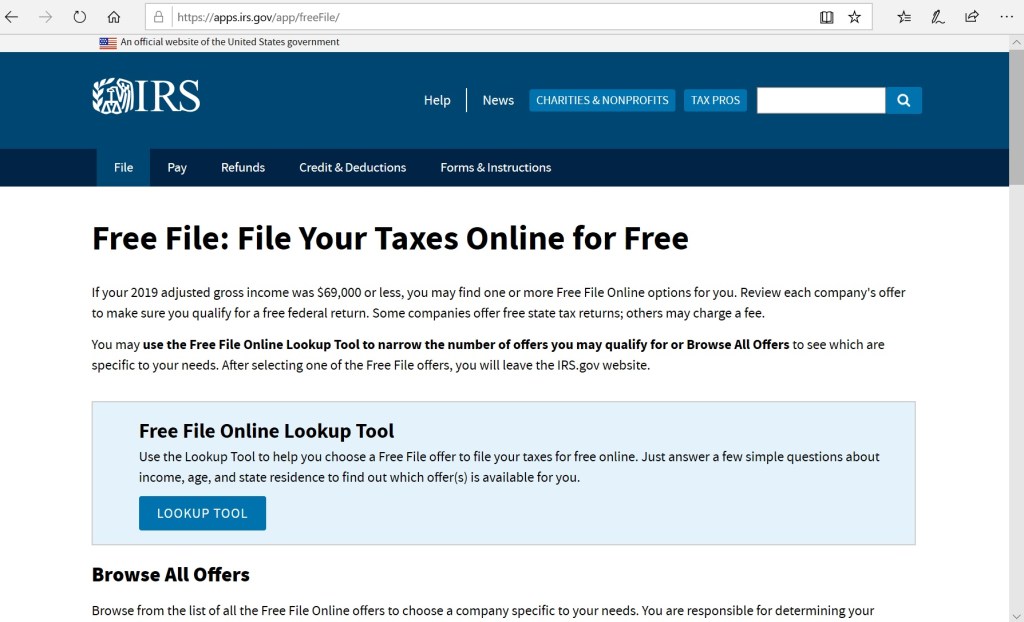
Access Free File HERE

The page you see when you click the link above will look something like this.

Using SparkNotes to Read Difficult Texts

One strategy I use to read difficult texts is looking at the SparkNotes page for them before even opening the book. SparkNotes is a website that gives overviews of many classic literary texts, along with some philosophy and other subjects. By reading the SparkNotes page before the actual text, you can jump into the text with a basic understanding of what it’s about. This makes it easier to understand, which means you can dedicate your energy to picking up interesting details for class discussion or even an essay, rather than just trying to understand what the writer is saying.

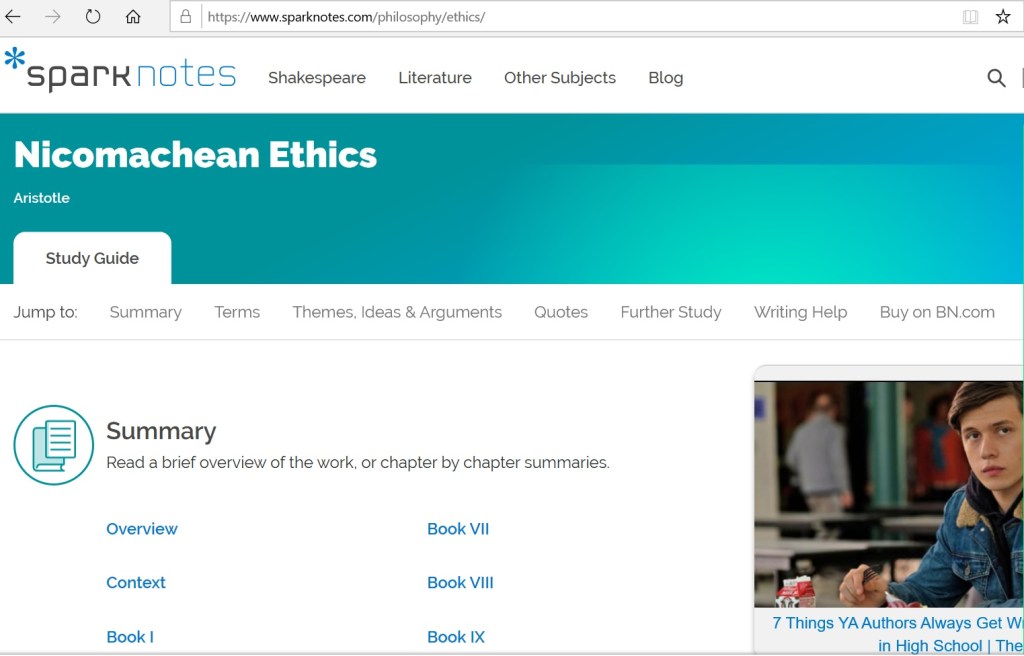
If you’ve taken an Odyssey class in philosophy, you’ve probably read bits of Nichomachean Ethics by Aristotle. Let’s take a look at the SparkNotes page.

Notice the advertisement on the right hand side. One downside to SparkNotes is that it has a lot of advertisements, and tempting ones at that, so it’s best to only visit the site when you’re not in a very clicky mood. To get to this page, I just searched “nichomachean ethics” on the homepage.

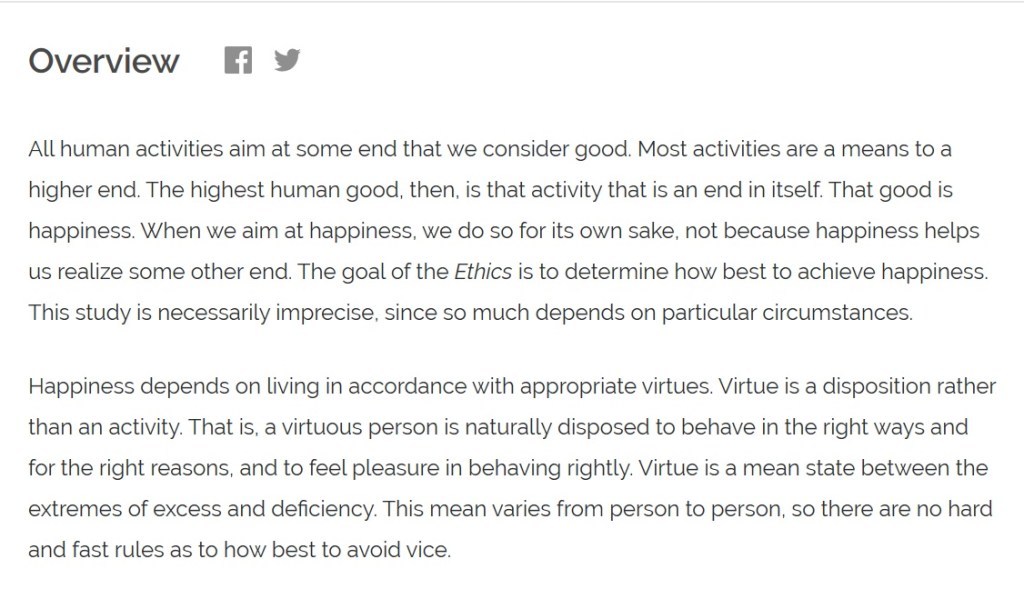
Below is a little snippet of the overview SparkNotes gives on Nichomachean Ethics. The entire thing, which I didn’t have space to paste, is about a page and a half long. You can read it here.

SparkNotes can give you a surface level understanding of a text, so it’s easier for you to read below the surface.

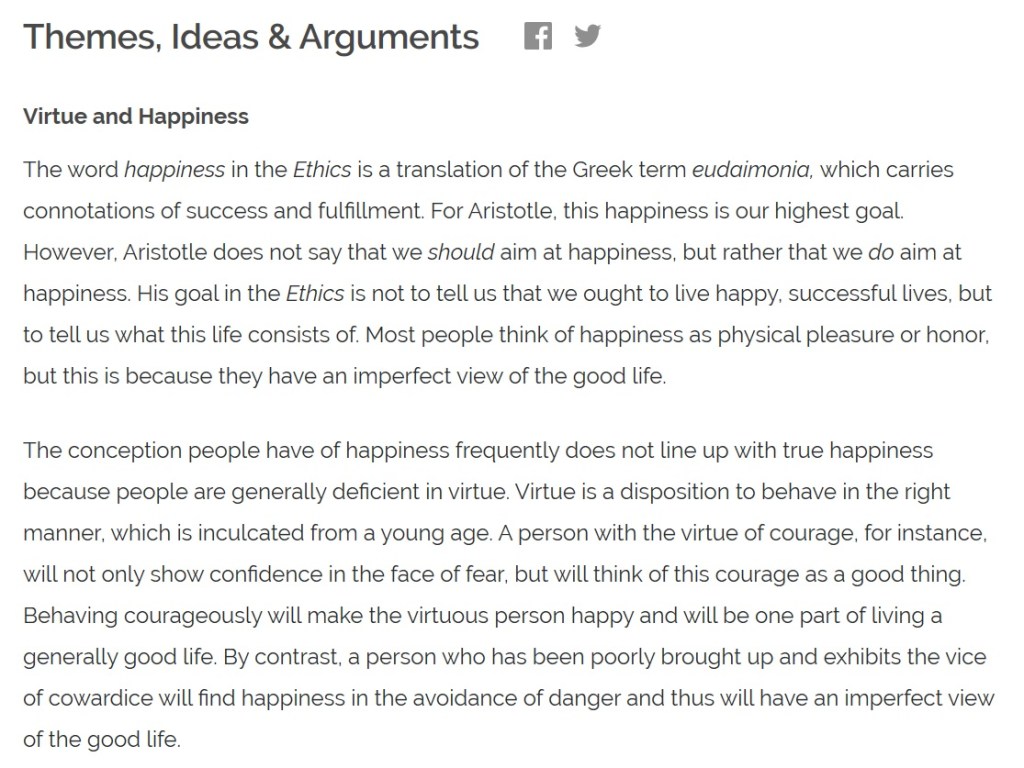
Below is a glance at the Themes page. For those of you who studied Nichomachean Ethics with Odyssey, a lot of this should sound familiar. We’ve talked about these themes in class every time I’ve seen it taught.

SparkNotes also tells you about key themes to watch out for.

Take note that SparkNotes and similar websites are not substitutes for reading difficult texts. Rather, they are a tool that can be used to experience difficult texts on a higher level. If you have a basic understanding of a philosopher’s argument, it will be easier, once you read his or her actual words, to do things like point out contradictions, places where elaboration is needed, and much more. SparkNotes is also useful for literature and some poetry. If you had trouble understanding the short story “The Yellow Wallpaper” that was posted on this blog last week, you might check out its SparkNotes page!

For texts like Nichomachean Ethics, which were translated from Ancient Greek, and thus have very dense language, SparkNotes can be a godsend. However, don’t shy away from utilizing it to gain a basic understanding of texts that appear simple before diving into them, as well. Happy reading!

Writing the Personal Statement

By the Writer’s Workshop at University of Illinois at Urbana-Champaign

Personal Statements

Overview

Personal statements (sometimes called “application essays or “statements of purpose, are written in response to a question or questions on a graduate or professional school application form that asks for some sort of sustained response. Some applications ask more specific questions than others. There is no set formula to follow in shaping your response. Personal statements can vary in length from a couple of paragraphs to a series of 1-2 page essays. Personal statements are important when applying to an extremely competitive program where all the applicants have high test scores and GPAs-use them to stand out from the crowd!

Context Considerations

Know your audience: Figure out who will read your statement. For professional school applications, your personal statement may be read by an admissions committee that includes admissions staff members and faculty. For graduate school applications, your personal statement will most likely be read by professors who serve on an admissions committee in the department or program to which you are applying. A good way to think about your audience is as knowledgeable non-specialists. They know a lot, but might not know a lot about your specific sub-discipline.

Make choices based on your audience, for example about whether your statement should be more autobiographically focused or more professionally focused.

Do your homework: Show that you know about the program/department, its specialties, its people (faculty, current graduate students, etc.) and what it might be looking for in new graduate students.

Understand the personal statement as part of your ”package”: Use it to show aspects of yourself that are not developed in other materials contained elsewhere in the application. Demonstrate clearly and effectively what makes you a unique candidate.

Strong personal statements:

  • Answer all the questions asked and are honest and confident in their content
  • Develop an argument early in the essay and argue it throughout
  • Are coherent and interesting, with an excellent first paragraph and 2-4 main ideas
  • Have perfect spelling and mechanics
  • Demonstrate knowledge about the school/program
  • Show maturity, professionalism, and intellectual readiness for the program

Try to avoid:

  • Using empty or vague words
  • Repeating information directly from the application form
  • Emphasizing the negative. Explain what you feel you need to, but do so positively
  • Using clichés (“a fish out of water, “a chip off the old block,”‘ “beyond a shadow of a doubt,” e.g.)

Getting Started: Try answering the following questions to brainstorm ideas for your statement:

  • When did you initially become interested in your chosen major or career?
  • How did that interest develop?
  • When did you become certain that this is what you want to do?
  • What attracts you to this discipline or career?
  • What kind of work or projects that are related to your interests and/or this discipline and/or career have you found rewarding?
  • What do you expect to get out of this program/experience/degree?
  • What life experiences have prepared you to succeed in this program or to pursue graduate education?
  • What personality traits set you apart from others? Why and how?
  • What life experiences have you had that are different from those of other potential applicants?

Other Tips:

  • Sometimes it’s helpful to think of quality over quantity. Don’t feel that you need to reach the word limit, and in some cases, those who read your applications may value conciseness.
  • Think of the “bigger picture” when writing about your experiences. Rather than simply describing your experiences, also explain what you learned from them and why they motivate you to pursue graduate school.
  • Demonstrate “fit” with the programs (e.g. faculty, program resources). Help the readers understand why the program will help you develop your professional/academic interests, and how you can contribute to the program and field.
  • See our website: https://writersworkshop.illinois.edu for more information.